
A clear, timely hypothesis helps your team understand and document the technical question being tested and why the work may qualify as experimental R&D. A common weakness in R&D claims is the absence of evidence of a hypothesis recorded at the time. It should be recorded before the relevant experimental work begins, not reconstructed later during registration or an audit.
Use this guide to help your team document its hypothesis and support compliance with the R&D Tax Incentive scheme .
When should you write your R&D hypothesis?
To support your R&D Tax Incentive assessment and compliance, you should meet with your R&D team at the beginning of the income year to create, review, and/or update your core activity hypothesis.
It is crucial for your team to create your hypothesis before you start your core R&D activities. You will need evidence that you developed your hypothesis before beginning R&D work.
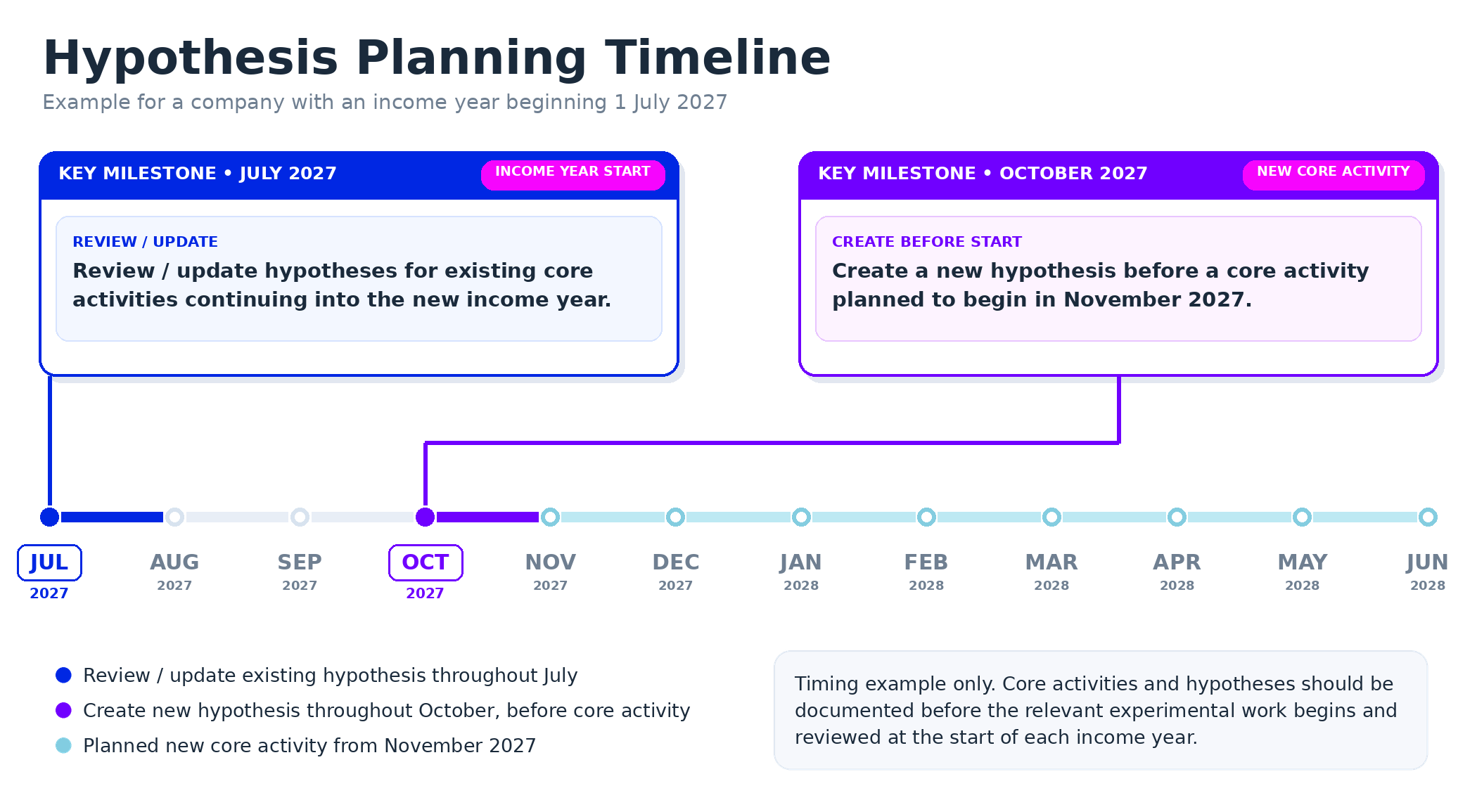
The R&D Tax Incentive statute applies on an income-year basis. This means even if your core activities extend across multiple years, the hypothesis must be reviewed at the beginning of your income year. Below is an example of a hypothesis planning timeline:
You’ve organised a R&D Hypothesis Review, what next?
How to write a core activities hypothesis
Your hypothesis is your idea or proposed explanation for how you could achieve a particular result and why that result may be achievable. It is a concrete technical limit paired with a testable method and measurable criteria. You may express your hypothesis in a single statement or in several statements that set out what you plan to do and why.
We know most businesses don’t usually use the word “hypothesis” in their day-to-day work. That’s okay; the law doesn’t require academic language. What matters is having a dated record, made before the experimental work starts, that sets out what you’re trying to find out technically and how you plan to test it. It could be in meeting notes, a project brief, an email or your usual project system.
You need to explain what result you aim to achieve combined with how and why you think you can achieve it, informed by background research.
Focus on what you expect to happen technically, not what you hope to achieve commercially. Predict how a material, process or system will behave, rather than whether it will increase sales, reduce business costs or attract customers.
Ask: What technical change do we predict will produce what observable result, under what conditions and why? Commercial benefits can explain the project’s motivation, but they should not replace the technical prediction.
R&D hypothesis examples
Below are some examples of compliant vs. non-compliant hypotheses for R&D Tax Incentive Core Activities.
| Compliant Hypothesis | Non-compliant Hypothesis | |
|---|---|---|
| Example | “We hypothesise that processing only records that have changed, rather than reprocessing the full dataset, will reduce median execution time by at least 30% across repeated tests on datasets of 100,000 records, while keeping the output discrepancy rate below 0.1%. This is expected because unchanged records will not need to be recalculated.” | “The new software will reduce operating costs.” |
Is it sufficiently framed? Why/why not? | Why it is sufficiently framed:
| Why it is not sufficiently framed
|
Reviewing and updating your core activity hypothesis
Even where a core activity continues across multiple income years, you still must review your hypothesis at the start of each financial year to confirm it still reflects the unresolved technical question, current knowledge and planned experiments. Update it where the previous year’s results or changed circumstances have altered the expected technical outcome, proposed explanation or measures of success. Retain records of the review and any revisions.
R&D hypothesis checklist:
- Your R&D team has met to create, review & update R&D core activities hypothesis.
- You have evidence that the hypothesis was review/updated with timestamps, such as meeting minutes or Jira entry comments.
- Your hypothesis includes what results you aim to achieve.
- Your hypothesis includes how and why you think you can achieve those results.
- Your hypothesis focuses on technical barriers and physical/computational limits. It does not focus on commercial viability or product features.
- You can demonstrate that New Core R&D Activities did not begin before the hypothesis was written, for example through dated meeting minutes.
Still have questions about timing, evidence or updating your hypothesis? Read our R&D hypothesis writing FAQs.
Need assistance with your R&D hypothesis?
Have questions about writing or reviewing your R&D hypothesis? BlueRock's R&D Tax Incentive specialists help businesses assess their eligibility and work through the application process. Get in touch via the form below.